Hands-On Review
Are Financial Certification Question Banks on Shopee Worth Buying? An Honest Review of SK Interactive Notes
Official examination bodies only provide past papers from the last three sessions without answer explanations—so what exactly do you get from a NT$300 to NT$500 (New Taiwan Dollar) interactive question bank on Shopee? I analyzed all 25 question banks from SK Interactive Notes, breaking down pricing, question volume, delivery logistics, and the non-refundable risks involved.

Among my friends preparing for financial certification exams, the bottleneck is almost never finding practice questions—it's finishing a test and having no clue why they got an answer wrong. A while ago, someone sent me a link to a Shopee store, claiming its question banks let you practice directly in your web browser and even automatically collect your mistakes. My immediate reaction was: official past exam papers are already free, so why spend NT$300 to NT$400 (New Taiwan Dollar) buying them?
I thoroughly combed through the store and cross-checked the free resources available across the official websites of the Taiwan Academy of Banking and Finance (TABF), the Securities and Futures Institute (SFI), and the Ministry of Examination (MOEX). Laying out all the publicly available pricing, question counts, delivery methods, and official materials side by side, here's my analysis to help you decide whether this money is actually worth spending.
When preparing for financial licensing exams, the most time-consuming part is never finding questions—it's figuring out why you got them wrong. (Illustrative image, AI-generated)
What Exactly Is This Store Selling?
The store is called "SK Interactive Notes" (Shopee username: u121848660). It opened in September 2016 and is registered in Sanchong District, New Taipei City. When I checked on September 6, 2026, the storefront displayed 28 items, with 25 product listings showing active pricing. Filtering out duplicate listings for the same subjects, there are roughly 23 distinct subjects—all digital, interactive question bank files for financial certifications, with zero physical books. The store has accumulated 183 positive reviews, 0 negative reviews, an average rating of 4.99 stars, 303 followers, a 100% customer service response rate, and an average response time of about 23 minutes. Its track record is remarkably clean.
What it sells isn't standard PDFs, but standalone single-file HTML documents that run directly in your browser—no app installation, no internet connection required, and no subscription fees. When answering questions, the answers are initially hidden. You get instant grading with a single click, incorrect answers are automatically logged into a mistake notebook, and high-frequency test questions can be filtered out for targeted drill practice. The format's advantages are straightforward: no need to download dedicated apps, no recurring annual subscriptions—once you buy the file and save it, it's yours.
Price Ranges and Cost-Per-Question Across 25 Question Banks
Prices are based on what I verified on September 6, 2026. Shopee sellers tweak pricing from time to time, so actual figures may vary based on current product listings.
The cheapest option is the Postal Exam - Three Postal Acts question bank, offering 580 questions for NT$249. At the NT$259 price point, there are four subjects: Basic Test on Sustainable Development (ESG) with 1,200 questions, Senior Financial Planning Consultant with 1,200 questions, Asset Securitization with 1,000 questions, and Derivative Financial Products Sales Personnel with 1,200 questions. The FinTech Knowledge Examination (1,675 questions) is priced at NT$279. The NT$329 tier covers Stock Affairs Personnel (1,000 questions), Enterprise Internal Control Basic Competence Examination (2,880 questions), Securities Investment Trust and Consulting Regulations single subject (1,750 questions), and Anti-Money Laundering and Countering the Financing of Terrorism (AML/CFT) (2,640 questions). Trust Specialist and Junior Credit Specialist (2,860 questions each) are both priced at NT$380.
The NT$399 tier includes Futures Specialist (3,600 questions), Junior Foreign Exchange Specialist (3,250 questions), Bank Internal Control and Internal Audit (both General Finance and Consumer Finance tracks, 3,250 questions each), and Junior Securities Specialist (3,500 questions)—all at the same price. The most expensive single-subject offerings are the 3-subject bundle for Securities Investment Trust and Consulting Specialist (5,200 questions) and Senior Securities Specialist (5,400 questions), both priced at NT$499.
The Certified Public Bookkeeper (CPB) series has the highest unit prices in the store. Fundamentals of Accounting (210 multiple-choice questions plus 32 essay questions) is listed at NT$449; Tax Filing Practice (41 major essay questions) is listed on two different pages at NT$349 and NT$449; Tax Regulations (500 questions) costs NT$349; and a dual-subject bundle combining Bookkeeping and Tax Regulations (1,000 questions) goes up to NT$599. Complete subject bundles range between NT$899 and NT$1,199, with 4-subject and 5-subject options available across two different package listings with slightly different price ranges. Additionally, the entire store offers a NT$20 discount coupon.
When broken down by unit cost per question, the spread is substantial: Senior Securities Specialist gives you 5,400 questions for NT$499, averaging less than NT$0.1 per question, whereas the Postal Exam Three Postal Acts costs NT$249 for 580 questions, working out to roughly NT$0.43 per question. The larger the question volume for a given subject, the more cost-effective each question becomes.
How Much Free Material Do Official Sources Actually Provide?
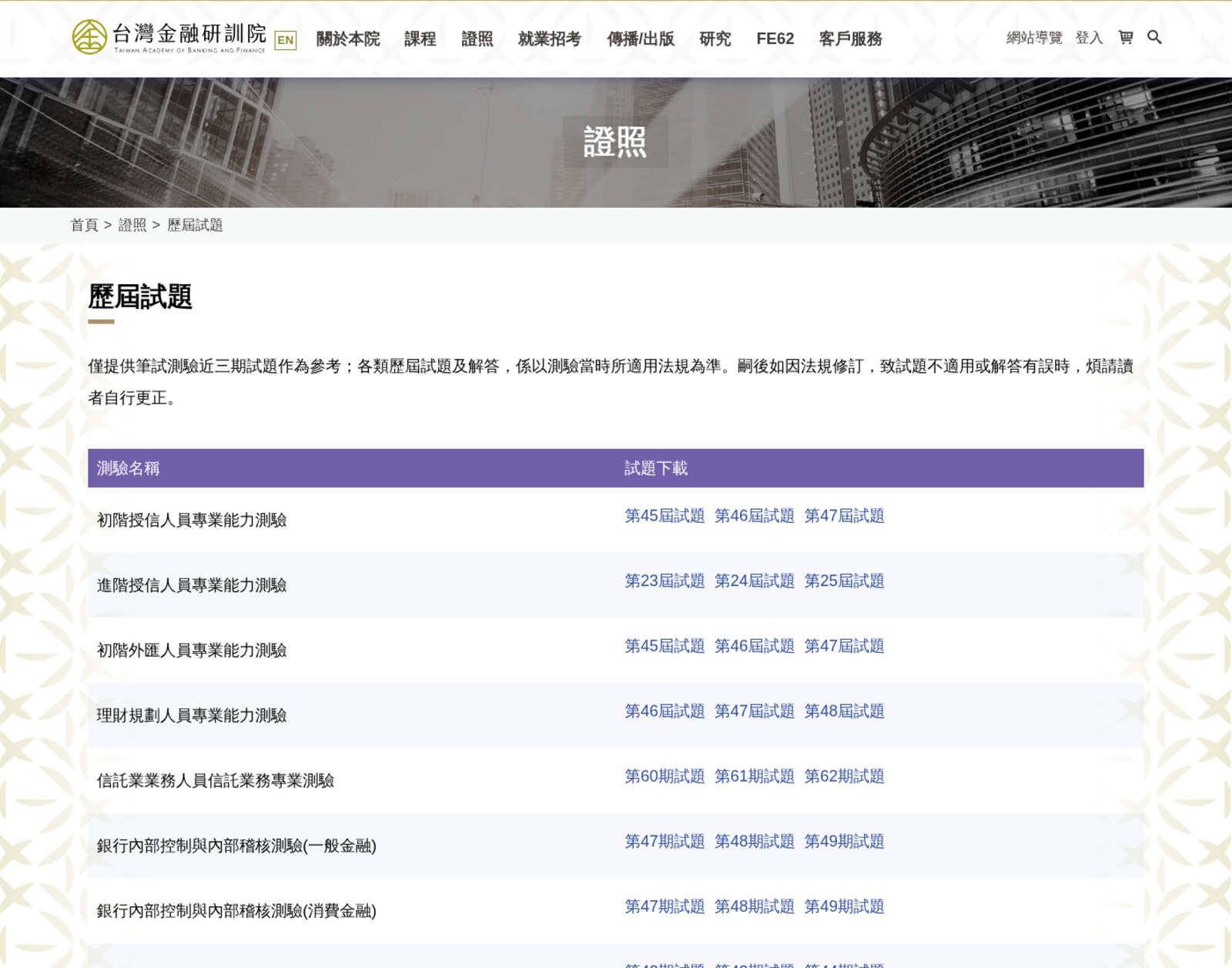
The TABF official website explicitly states: "Only the past three written test sessions are provided for reference." Junior Credit Specialist only covers sessions 45 through 47, and Trust Specialist only covers sessions 60 through 62. (Source: Screenshot from Taiwan Academy of Banking and Finance official website)
The Taiwan Academy of Banking and Finance (TABF) website is very blunt about it: "Only the past three written test sessions are provided for reference." When I checked, Junior Credit Specialist only had sessions 45 through 47, Trust Specialist had sessions 60 through 62, and Bank Internal Control and Internal Audit had sessions 47 through 49. Earlier years simply aren't available. The official site also explicitly cautions that "all past exam questions and answer keys reflect the laws and regulations applicable at the time of testing," meaning if regulations have changed since then, candidates have to identify and correct outdated answers themselves. Furthermore, the Financial Intelligence Test (FIT) stopped releasing questions and answers after its 3rd session, and the Basic Test on Sustainable Development currently only posts the two sessions from 2025 (Year 114).
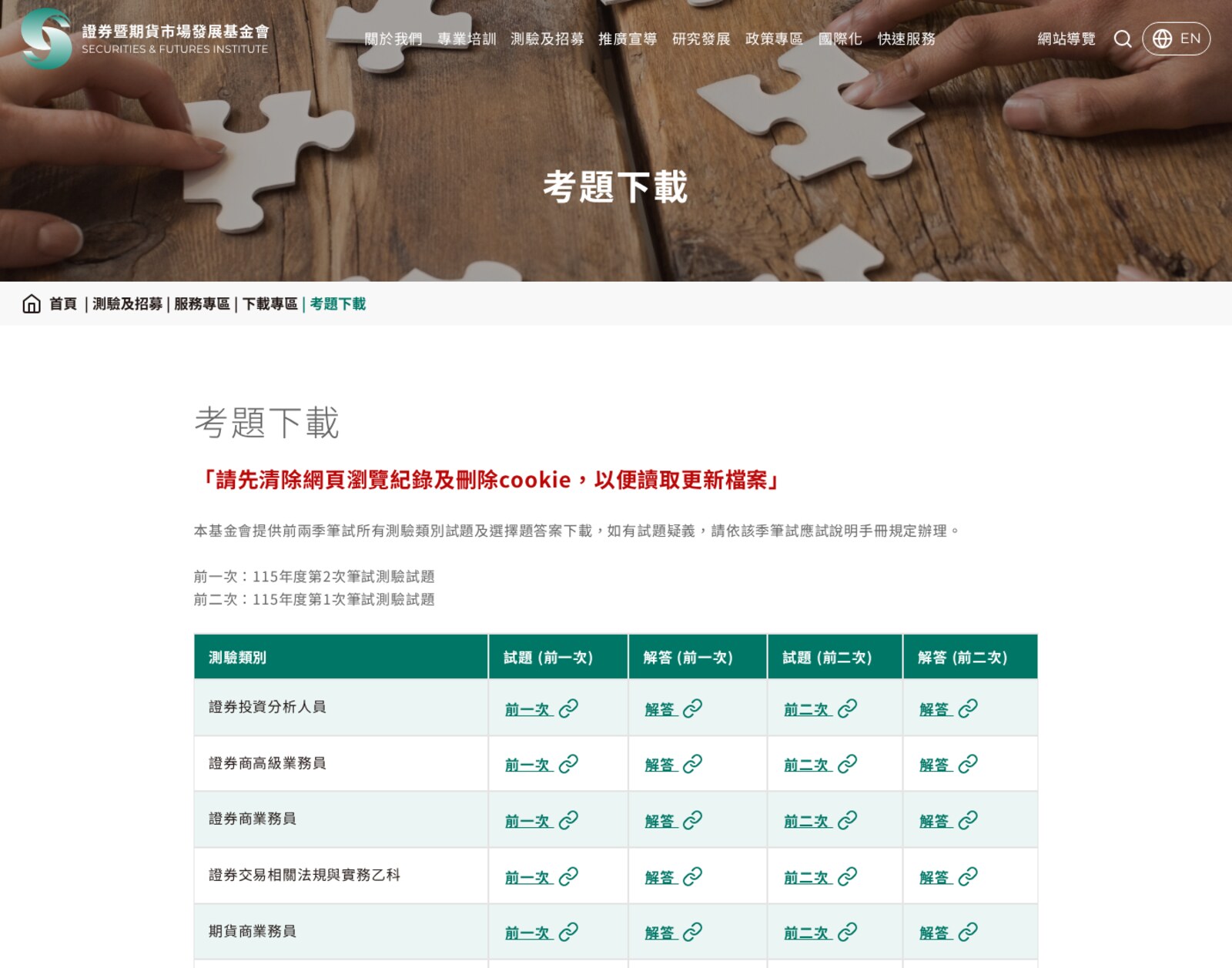
The SFI only offers the previous two quarters—and that's just questions plus multiple-choice answer keys, with zero answer explanations. (Source: Screenshot from Securities and Futures Institute official website)
The Securities and Futures Institute (SFI) releases even less. Its exam download page explicitly states that it only provides questions and multiple-choice answer keys for the previous two written test sessions. When I checked, only the 1st and 2nd sessions of 2026 (Year 115) were available—and that was strictly questions and answers, completely devoid of explanations. Major certifications like Junior Securities Specialist, Senior Securities Specialist, Securities Investment Trust and Consulting Specialist, Futures Specialist, and AML/CFT all fall into this category.
The Certified Public Bookkeeper (CPB) exam, categorized under the Ministry of Examination's (MOEX) Senior and Junior Examinations for Professionals and Technologists, is a completely different story. The MOEX platform publishes all test questions and official multiple-choice answer keys dating back to 2003 (Year 92) completely free of charge, uploading them by 10:00 AM the morning after each written exam concludes. In other words, CPB questions themselves are completely free and span decades; buying a question bank from this store means you are paying entirely for detailed answer explanations, sample essay answers, and the interactive test interface—not for the raw questions.
Comparing these three official websites makes one thing clear: what examinees are really paying for isn't the questions themselves. They’re paying someone to round up scattered past exam papers across years, annotate every single option with clear explanations of why it’s right or wrong, and bundle everything into an interactive interface for immediate practice. When official portals only hand out two or three exam sessions with zero explanations, that exact gap is where paid question banks derive their value.
Compared to Official Paper Workbooks, Is the Pricing Reasonable?
A comparison with TABF's official publications makes this very clear. Take Trust Specialist as an example: TABF's official Trust Specialist Professional Competence Examination Past Exam Papers with Detailed Explanations (2026 Edition) lists for NT$380 (discounted to NT$342 on their official online bookstore). The store's Trust Specialist interactive question bank is also priced at exactly NT$380, packing 2,860 questions. For Bank Internal Control and Internal Audit, TABF's official Past Exam Papers with Detailed Explanations (2025 Edition) is priced at NT$380, while another volume, Bank Internal Control and Audit: Key Concepts and Exam Analysis (2024 Edition), lists for NT$680. The store's General Finance edition packs 3,250 questions for NT$399.
Both sit in the exact same price bracket; the real difference comes down to the format and question volume. Official publications are physical books backed by reputable publishers that you can browse in a bookstore before buying. The store offers digital files containing nearly ten times as many questions with real-time scoring—the downside being that you cannot preview sample chapters before placing an order.
From an exam prep efficiency standpoint, going through a paper workbook for the third time often leads you to memorize answers simply by where they sit on the printed page, making true blind re-testing difficult. Digital files shine when it comes to hammering away at mistakes repeatedly. However, if your study routine relies on highlighting paper pages, jotting margin notes, or casually flipping through a book during your commute, picking up the official NT$380 book is well worth it. It really comes down to how you study best.
Delivery Method and Overlooked Shipping Costs
Because Shopee lacks a native delivery mechanism for purely digital goods, this seller has you submit your email address via Shopee Chat after ordering; within business hours, the personalized digital file is emailed to your inbox within 3 hours at most. On the same day, the seller ships a physical "File Retrieval and User Guide Card" via store-to-store logistics. This card is merely a procedural accessory: since you receive your digital file the same day, you can jump straight into studying without waiting 2 to 5 business days for convenience store delivery. You will, however, still need to pick up the card at the convenience store once it arrives to complete the order. Given the seller's 100% response rate and average response time of roughly 23 minutes, requesting the file via chat is generally hassle-free.
Because a physical card is shipped, you must pay attention to shipping fees at checkout. Shopee Store-to-Store standard shipping is NT$45 per order (tax included), or NT$60 if you select package-free next-day delivery—though the final amount depends on whether the store offers free shipping thresholds. This fee stings particularly on lower-priced subjects: adding NT$45 shipping to a NT$249 Postal Exam question bank increases the total cost by nearly 20%. Make sure to check the grand total before paying.
Three Critical Limitations to Know Before Ordering
First, digital goods are exempt by law from Taiwan's statutory 7-day cooling-off period (appreciation period). The seller explicitly states that once files are emailed out, no returns or refunds are accepted. Under the Consumer Protection Act's regulations on non-tangible digital content, this means you cannot sample the material beforehand, nor can you change your mind after payment. For buyers who prefer reading a sample chapter before committing, this is the biggest hurdle.
Second, each file is embedded with a personalized watermark. The seller notes that traceability measures are in place, strictly prohibiting resale, lending, or public dissemination. It is strictly for single-user personal use, ruling out splitting costs with study buddies.
Finally, there is the issue of version timeliness. The seller explicitly advises buyers to purchase "1 to 1.5 months before your exam date to obtain the version closest to the test." This means that while question banks are updated as regulations change, updates only apply to new orders—they aren't retroactively pushed to previous buyers. If your exam is still more than half a year away, buying too early means your copy might no longer be up to date by test day.
The Bottom Line: Is It Worth Your Money?
If you're still on the fence about whether to take the exam and thinking about buying a question bank just to force yourself to start studying, hold on to your wallet. Digital files are non-refundable, and if you end up not sitting for the test, it's pure sunk cost. Start by downloading the free past exams from official websites to see if you can stick with the study routine before spending any money.
If you're committed to sitting for the exam and have ample prep time, subjects under the SFI and TABF umbrellas offer the highest value. These include Senior Securities Specialist, Securities Investment Trust and Consulting Specialist, Futures Specialist, Trust Specialist, Junior Credit Specialist, and Bank Internal Control and Internal Audit. Because official sources only provide two or three sessions without explanations, the time spent scavenging older exam papers and verifying correct answers far outweighs the NT$300 to NT$500 cost of the files. What's more, for mammoth question sets like 5,400 questions for Senior Securities Specialist or 5,200 questions across the 3 subjects for Securities Investment Trust and Consulting, the cost works out to less than NT$0.1 per question—making the gain in study efficiency well worth the price.
The Certified Public Bookkeeper series warrants a second thought. MOEX provides comprehensive past exams and official answer keys dating back to 2003 for free. With this question bank starting at NT$449 per subject and bundles easily exceeding NT$1,000, what you’re paying for is entirely explanations, sample essay answers, and the testing interface. Compared to other certifications where even getting hold of past questions is a struggle, the justification for buying the CPB bank is considerably weaker. I'd recommend doing the official free questions first; only open your wallet if you genuinely hit a wall and can't figure out why your answers are wrong.
Before placing your order, remember to check the store-to-store shipping fee on the checkout page, and keep in mind the seller's recommendation to buy 1 to 1.5 months before your exam so you don't miss recent regulatory amendments. If you want to check the full subject list and current pricing, the seller's storefront has over twenty question banks so you can pick the exact exam you're targeting.
Sponsored