Hands-On Review
Claude Fable 5.1 Is Live: Why Your $20/mo Claude Pro Plan Doesn't Actually Include It, and How to Choose Between the Big Three AI Subscriptions
Claude Fable 5.1 launched on September 1 and shot straight to the top of Hacker News—yet official docs state it isn't included in Claude Pro's quota. Here's a breakdown of the real-world differences and local NT$ pricing across Claude, ChatGPT, and Gemini at the $20, $100, and $200 tiers, for anyone on the fence about which one to renew.
Late the other night, I was scrolling through Hacker News when Anthropic's announcement thread for Claude Fable 5.1 and Mythos 5.1 was sitting right at the very top, racking up over a thousand points. By the next day, people in my group chats were already asking me which subscription they should renew now. Having paid for all three services myself, I put together this breakdown of their current pricing, restrictions, and one massive trap that's remarkably easy to fall into.
Let's start with that trap: Fable 5.1 is the star of the show here, but if you're paying $20 a month for Claude Pro, you don't actually get to use it—at least not in the sense of "subscribe and use it with peace of mind."
What Did Fable 5.1 Actually Upgrade?
The new model went live on September 1, succeeding June's Fable 5 generation. Among the numbers released by Anthropic, the biggest leap is in scientific tasks: Terminal-Bench-Science 0.1 jumped from 24.7% on Fable 5 to 52.6%, more than doubling. On the coding front, Terminal-Bench 4.0 came in at 55.8%, while CursorBench 3.2.0 improved from 70.5% to 73.4%—a much more modest gain. On Humanity's Last Exam, it scored 60.9% without tools and 65.0% with tools.
In terms of specs, it features a 1-million-token context window and a single-output cap of 128k tokens. API pricing holds steady with no price hike at $10 per million input tokens and $50 per million output tokens, but cache reads were slashed by 75%. Anthropic claims overall costs drop by roughly 25% for typical workflows and up to 45% for heavy agentic tasks.
Two new features feel particularly notable. First, you can adjust thinking intensity mid-conversation across five levels: Low, Medium, High, XHigh, and Max. Second, citations and source attributions are now attached to outputs, implemented in response to the EU AI Act. As for Mythos 5.1, the official word is that it's essentially the same underlying model as Fable 5.1 with different safety guardrails, restricted exclusively to a trusted access program for cybersecurity and life sciences. Everyday users won't have access to it, so you can safely skip past it.
The cost of this new "thinking intensity" dial is illustrated best by Simon Willison's famous "draw a pelican on a bicycle" benchmark. At Low and Medium, it barely deliberates, costing around 10 cents a pop. Step up to XHigh, and it churned for over seven minutes, spitting out 36,767 tokens—which works out to about $1.80 at official rates. Dial it up to Max, and you're looking at nearly 14 minutes, 65,927 tokens, and $3.30 for a single prompt. The output definitely improves every step of the way, but the price difference is tens of times higher, not just a modest percentage bump. You'd never need these top two tiers for casual chatting; what truly burns through cash is feeding it long-running reasoning tasks.
The Real Trap: Pro Can't Actually Use Fable
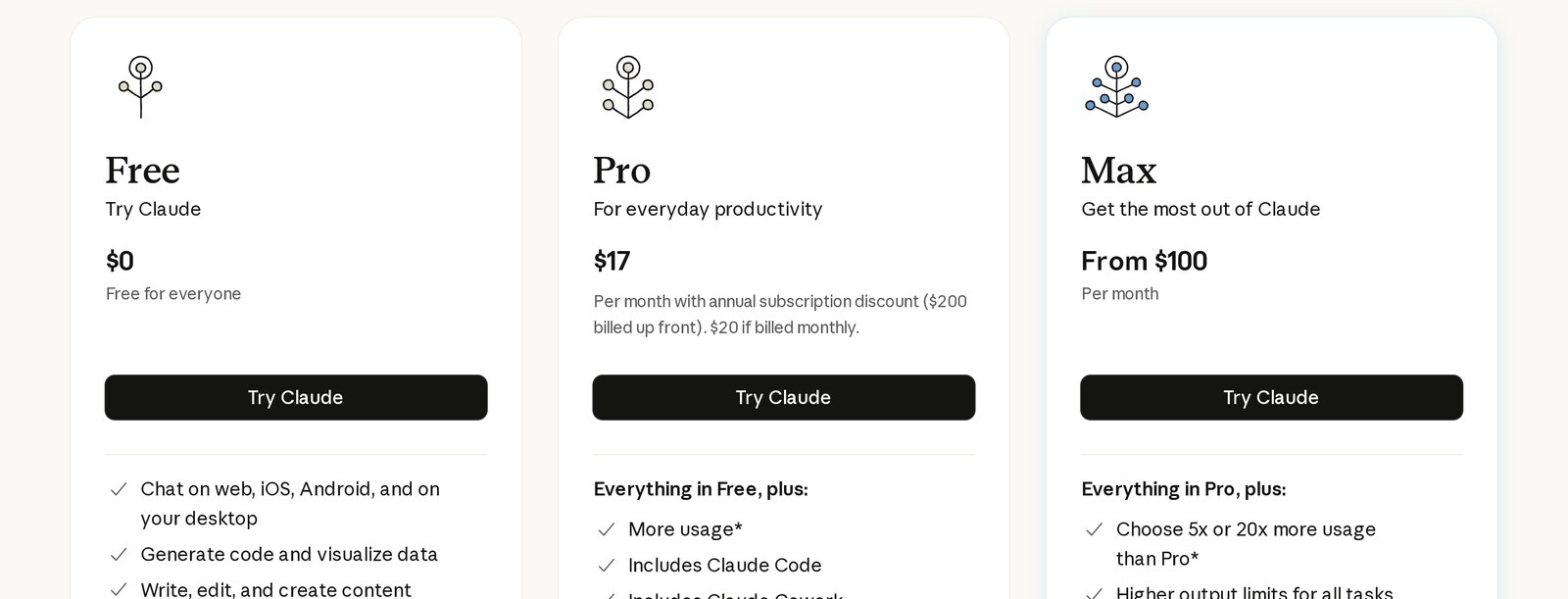
Claude's personal plans are split into Free, Pro, and Max tiers. Pro costs $20/month or an average of $17/month billed annually, while Max starts at $100/month. (Image source: Screenshot from Claude's official pricing page)
Anthropic's official support documentation pulls no punches. For the Free plan, it plainly states, "Fable 5 isn't available on the Free plan"—meaning it simply isn't there, leaving Sonnet 5 as the workhorse for free accounts. As for how many queries free users get per day, Anthropic hasn't disclosed hard numbers; in practice, you chat for a bit, hit a wall, and have to wait a few hours to return. For Pro ($20/month, or $17/month billed annually, roughly NT$ 650 (New Taiwan Dollar)), the phrasing is: "Fable 5 and Fable 5.1 aren't included in your plan's usage limits. You can use them with usage credits." Translated into plain English: you can see it in the model picker and you can click it, but that usage isn't included in your subscription quota. Instead, you're billed separately at standard API rates—$10 per million input tokens and $50 per million output tokens.
Let's clarify what kind of trap this is so nobody panics. It's not the kind where money is silently stolen from your account without you noticing. If you haven't enabled extra usage, once your allowance runs out, it simply stops you from submitting prompts; it won't spontaneously charge your credit card. The real trap is the expectation mismatch: Fable 5.1 sits right there in the model dropdown, welcoming your click, and it actually runs when selected. Yet the billing rules are tucked away in a separate support doc, and nothing on screen warns you, "This prompt is billed differently from other models."
What does this extra toggle actually look like? It doesn't require signing up for a developer API key. Instead, you toggle on "Extra Usage" under your Claude account's billing settings and pre-fund an account balance. Any requests exceeding your subscription quota are then automatically deducted from that balance at API rates. Keep in mind this toggle is exclusive to paid plans; free accounts cannot unlock Fable simply by loading credits. It functions on a prepaid basis rather than an open credit card tab charging without limits—you can only spend what you've loaded. On top of that, you can set monthly spend caps and auto-reload thresholds; once you hit that ceiling, auto-charges halt, and funds already deposited don't expire in most regions. So "accidentally running up a massive bill" is preventable, provided you take the time to configure those caps. Anthropic hasn't specified a minimum top-up amount—you type in how much credit you want to purchase, up to a daily limit of $2,000—so topping up just a few dollars to dip your toes in is completely doable.
Two other practical questions always come up. First, Fable draws strictly from that extra usage balance, which is entirely separate from your standard subscription allowance for Opus 5 and Sonnet 5 (the ones that refresh every 5 hours and weekly). Using Fable won't secretly chew through your regular chat quota, and vice versa. Second, if a Pro account hasn't turned on extra usage, Fable may still be clickable in the menu, but it includes zero free allowance—submitting a prompt immediately blocks you with a prompt to enable extra usage first. There's no leeway to "test out a few queries for free."
If You Turn On Extra Usage, How Much Extra Does It Actually Cost?
Anthropic doesn't provide a conversion calculator, so I ran the numbers using their published rates to give you a rough sense of scale. When chatting with a bot, every new message re-sends the entire preceding conversation history as input tokens. That means the deeper you get into a conversation, the pricier each turn becomes. Taking a mid-conversation average where a round trip accumulates 10,000 input tokens and 1,500 output tokens, you're looking at $0.10 plus $0.075—about $0.18, or less than NT$ 6.
A quick caveat: this is an average, not a flat rate per turn. Opening turns are vastly cheaper, while deep conversations cost significantly more, so multiplying this out gives you an order of magnitude, not an exact accounting figure. Furthermore, this assumes standard Q&A without asking it to deliberate heavily. Thinking mode is permanently active on Fable; throw a difficult problem at it, and the tokens generated by its thinking process are billed at the full output rate. It's entirely normal for a single turn to leap to several tens of cents or even exceed a dollar—which is precisely where that $1.80 figure for XHigh came from earlier.
So here's the ballpark: a serious afternoon session running 30 to 40 turns will cost you $6 to $7. Over a month, that can easily surpass the $20 base subscription fee itself. Willison's $3.30 single-turn test was an extreme case with thinking pushed to Max, which isn't how you'd burn tokens day-to-day, but the psychological sensation of "every single sentence is ticking on the meter" is fundamentally different from an all-you-can-eat subscription.
To keep this estimate honest: the figures above reflect pricing without prompt caching discounts, effectively representing an upper bound. As mentioned earlier, prompt cache reads were discounted by 75% this round; cached inputs cost just 10% of the base input price, or $0.25 per million tokens. However, benefiting from caching requires re-sending the exact same lengthy context repeatedly within a short time window. That resembles programming with autonomous agents far more than casual, intermittent chatting, where cache hits are rare. Your actual spend will land somewhere between my numbers and a bit lower—just don't assume you'll automatically pocket that 25% discount.
Want Fable Bundled into Your Monthly Fee? The Bar Is Set at Max
The barrier to entry starts at the $100/month Max tier, and even then, Anthropic only lets you spend up to 50% of your weekly allowance on Fable. To be clear, that 50% doesn't mean "half your quota is locked away and only usable on Fable"; it means "at most half of your usage can go toward Fable." You can still spend the other half on Opus 5 or Sonnet 5 without wasting a drop. This cap shares the same cycle as your weekly limit, resetting once a week at an assigned time for your account. Hitting that 50% cap doesn't lock you out entirely, either; official documentation notes that you can continue running Fable via extra usage credits, or switch to another model and keep working. It follows the exact same path as Pro, except you've already received half your quota as bundled allowance.
So how much Fable do you actually get for that extra $80? Frankly, there's no clear answer, because Anthropic has never published conversion numbers. They only describe it as "5x or 20x more usage than Pro," while Pro itself lacks any absolute figure. Ranges floating around online claiming "hundreds of hours per week" are rough estimations based on user testing, and they vary wildly; I wouldn't recommend using them for budgeting. A far more pragmatic approach is to enable extra usage on Pro, load a few dollars, and run Fable for a while to see how much you burn through in a month before deciding whether to upgrade to Max.
Let's also clear up how Claude Code fits into this, because many people conflate the two. Claude Code itself is included with subscriptions—both Pro and Max get it. When using it interactively in your terminal or IDE, it draws from the exact same allowance pool you use for chatting on claude.ai, with no extra charge. What's excluded from the subscription is the Fable model, not the Claude Code tool. At the intersection of the two, billing is dictated by the model, not the interface. Official docs make it explicitly clear that these rules apply uniformly across the web, mobile, desktop apps, and Claude Code. So if you switch the model to Fable 5.1 inside Claude Code on a Pro account, you'll still be billed via extra usage credits—it doesn't magically become free just because it's running inside Claude Code. Conversely, using Opus 5 or Sonnet 5 inside Claude Code simply consumes your standard subscription quota without costing an extra dime.
At the Same Price Point, the Other Two Include Their Flagships
A side-by-side comparison makes the contrast glaringly obvious. ChatGPT Plus also costs $20 (around NT$ 690 in Taiwan), and its flagship GPT-5.6 Sol is readily available in standard chats. Google AI Pro costs $19.99 (NT$ 650 in Taiwan) and gives you Gemini 3.1 Pro, Deep Research, and Veo, along with a bundled YouTube Premium Lite subscription. Deep research isn't unique to Google, mind you—ChatGPT Plus includes Deep Research with 10 queries per month, and Claude Pro has its own Research feature. The three are basically tied on this front, so it shouldn't be your deciding factor. The real distinction remains what we started with: at the exact same price tier, Claude is the only one charging extra for its newest flagship.
The tightness of their restrictions also differs dramatically, and in completely different directions. On August 6 of this year, OpenAI shifted text-only chats across all plans to unlimited usage. Plus subscribers chatting with flagship models virtually never hit a wall now; caps only remain on image generation, file uploads, and voice mode. Google, on the other hand, shifted Gemini from "daily prompt counts" to a compute-based metric, factoring in prompt complexity, feature usage, and conversation length. It similarly refreshes every 5 hours while converging toward a weekly cap, with AI Pro bundling 1,000 AI credits for resource-heavy features like media generation. Overall, if you just want unlimited back-and-forth text chat at the $20 tier, ChatGPT is currently the most generous, while Claude is the easiest to bump against a ceiling.
To be fair, though: Claude Pro lacks Fable, but Opus 5 and Sonnet 5 are fully covered within the subscription quota. Furthermore, Anthropic's own model selection guide notes that "most tasks should start with Opus 5." Fable 5.1 is positioned for "heavy reasoning and extended agentic workflows," or as an escalation when Opus 5 at high thinking intensity still can't crack the problem. So for the average user, missing out on Fable doesn't mean you're getting a crippled Claude—you're just not getting the shiny toy making headlines.
Need Image Generation? Claude Is a Complete Dead End
This has nothing to do with how much money you pay. Claude can output vector graphics and layouts like SVG, HTML, and CSS. Claude Design, launched this past April, handles tasks like slide decks, prototypes, and one-pagers. That feature is built right into the subscription—available across Pro, Max, Team, and Enterprise—and currently carries a research preview tag at no extra cost. But Claude does not generate raster images like PNGs or JPGs, nor is it on the official roadmap. The widespread interpretation is that Anthropic is deliberately dodging deepfake risks.
So if your workflow frequently involves "draw me an image" or "make an illustration for a social media post," Claude can't deliver, no matter which tier you subscribe to. ChatGPT's Sora and Google's Veo are already baked into their respective $20 tiers, creating a very real dividing line.
High-Tier Plans: The Big Three Are Virtually Neck and Neck on Price
Claude Max offers two tiers: $100 and $200. When Anthropic quotes 5x and 20x here, the official page specifies "5x or 20x more usage than Pro"—the baseline is Pro plan usage, not Free. ChatGPT Pro mirrors this with $100 and $200 tiers offering 5x and 20x relative to Plus. Following this year's I/O, Google AI Ultra split its original standalone $249.99 plan into $99.99 (5x usage) and $199.99 (20x usage). Converted to local currency, both tiers across all three providers hover right around NT$ 3,300 and NT$ 6,500, virtually identical.
With prices virtually identical, it comes down to what extra perks they toss in—and what they offer differs substantially in character. Claude Max provides almost purely raw volume: higher quotas, larger single-output token caps, peak-hour priority, and early access to new features. There are no exclusive core capabilities completely out of Pro's reach. ChatGPT Pro, on the other hand, packs genuine extras: only the $200 tier unlocks GPT-5.4 Pro with double the context length, expands Deep Research from 10 to 250 runs a month, and lifts limits on file uploads and image generation. Google AI Ultra pours most of its upgrades into media generation credits and cloud storage. So if your pain point is simply "running out of quota," all three have you covered; if you're after specific features, you'll want to verify whether the provider you pick actually includes them.
To answer a lingering question from earlier: upgrading to the $200 tier doesn't loosen that 50% Fable ceiling. The official documentation cites a flat 50% for Max without differentiating between the 5x and 20x tiers. So while the 20x plan gives you a much larger overall bucket, the proportion you can spend on Fable remains capped at half.
Keep in mind that none of the three publish absolute figures like "1x quota equals X messages or Y tokens." Everything is calculated over rolling time windows—Claude computes usage in 5-hour blocks, reconciled against a weekly ceiling. So while 5x is indeed five times the base, you really need to use the $20 Pro plan for a month first to gauge whether 5x will actually be enough for you.
At the other end of the spectrum, entry-level tiers are where Claude is completely absent. On June 8 of this year, Google AI Plus dropped from $7.99 to $4.99 (around NT$ 165 in Taiwan), while doubling its cloud storage from 200GB to 400GB. You get surprisingly good value at this price point: Gemini 3 Pro, Nano Banana Pro for image generation, Veo 3.1 Fast for video generation, full access to NotebookLM, double the usage limit of the free tier, and a 128k-token context window. Where it falls short compared to the $19.99 AI Pro is that its model caps out at Gemini 3 Pro rather than the newer 3.1 Pro, offers lower quota multipliers, and omits YouTube Premium Lite. AI Pro serves as its direct step-up—everything Plus has for image and video generation is present on Pro, just with far roomier allowances. Meanwhile, ChatGPT Go sits at $8 (around NT$ 270). Claude offers no budget counterpart whatsoever, jumping straight from Free to $20.
Another variable that's easy to overlook is exchange rates. Because all these plans are billed in USD, whenever the NT$ fluctuates, your statement moves with it. My bill this month came out over NT$ 30 higher than last month despite keeping the exact same plan. If you want to keep costs down, annual billing is far more practical: paying $200 upfront annually for Claude Pro averages out to $17 a month.
So, Which One Should You Subscribe To?
If your primary AI workload revolves around coding and running long agentic tasks—especially if you work with Claude Code—Claude remains the top choice. Just go in with your eyes wide open: if you want dependable access to Fable 5.1, the true barrier to entry is the $100 Max tier, not the $20 Pro plan. If you stick with Pro, treat it strictly as an "Opus 5 subscription" to keep your expectations properly aligned.
If you're looking for an all-around utility player—writing, research, image generation, video clips, and the occasional bit of coding—both ChatGPT Plus and Google AI Pro offer far better bang for your buck at the $20 tier. Their flagship models are bundled directly into the base price, and both come equipped with visual media generation. Between the two, heavy users of Gmail, Google Docs, and YouTube should lean toward Google AI Pro, where the included YouTube Premium Lite effectively offsets a chunk of the monthly subscription.
If you're only an occasional user and aren't sure whether you want to commit to a recurring bill, starting with Google AI Plus at $4.99 is currently the lowest-friction entry point available. Try it for a month; if you find yourself outgrowing it, you can always step up.
One final reminder: pricing and usage caps change rapidly across all these providers—they've already tweaked things several times this year alone. Always verify the numbers shown in your account dashboard before submitting payment.
Sponsored
Related

Apple's Sept 10 Event Is Official: With a Rumored NT$60,000 Foldable iPhone Ultra, Should You Wait or Buy Current Stock Now?
Apple officially confirms its Sept 10 event at 1:00 AM. The first foldable iPhone is rumored to start around NT$63,000 for 256GB—roughly 1.6 times the current iPhone 17 Pro. Here is our breakdown of how to watch the livestream, whether the first-gen foldable is worth the gamble, and how to pick from in-stock models if you're on a budget.
Major Chrome Zero-Day Under Active Exploit: Edge and Brave Users Need to Update Too
Google confirmed that CVE-2026-85046 in Chrome's V8 engine was actively exploited in the wild before a patch was released. Rated at CVSS 8.8, this marks the sixth exploited Chrome zero-day this year. Because the flaw resides in the Chromium engine itself, browsers sharing the same foundation—like Edge and Brave—are all affected, and the Android version requires a separate update. Here is a walkthrough of how to check and update each browser.

LINE Is Deleting Accounts by Year-End: Heads Up If You Only Linked Facebook Without a Phone Number!
The notices claiming "LINE will delete accounts without a linked phone number by year-end" are real, but they only target one specific group: accounts linked solely to Facebook with no registered phone number. Here is how to check if you're affected, how to set up your phone number, email, password, and Apple/Google link all in one go, the major pitfall where linking a number deactivates another account, and the only path left if you're already locked out.